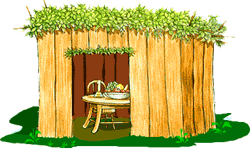
 Sukkah
A typical Sukkah.
For futher more info. on the sukkah check out the websites I have placed below:
- http://hillel.myjewishlearning.com/holidays/Sukkot/Overview_Sukkot_at_Home/Sukkah.htm
- http://www.aish.com/torahportion/shragasweekly/-_Building_a_Sukkah_-.asp
- http://www.amit.org.il/learning/english/Sukkot/
- http://www.sukkot.com/
- http://www.boker.org.il/

What Is A Sukkah?
A sukkah is a booth in which Jews are commanded to dwell during the festival of Tabernacles [Sukkot], as stated in the book of Leviticus (23:42‑5): "You shall live in booths [sukkot] seven days; all citizens in Israel shall live in booths, in order that future generations may know that I made the Israelite people live in booths when I brought them out of the land of Egypt, I am the Lord your God."
According to the Talmudic Rabbis, a sukkah has to have at least three walls (though the third need not be a complete wall) and a covering. It has to be at least 4 square cubits in size, but this does not necessarily mean that it has to have a square or oblong shape A circular sukkah, for instance, is valid provided it covers an area of at least 4 square cubits (a cubit is approximately 18 inches). The covering must be of things that grow from the soil (e.g. straw or leaves of trees), but it must be detached from the soil, so that it is not valid to use the leaves of a tree still growing from the soil as a sukkah covering. The covering has to have more shade than light; that is, there must be more covered than uncovered space. The covering can be quite thick, although lit is customary to make the covering sufficiently sparse for the stars to be seen through it. The sukkah has to be outdoors. A sukkah under a roof is not a valid sukkah, nor is it valid to have a sukkah underneath, say, the overhang of a balcony.
All full meals should be eaten in the sukkah, that is, meals at which bread is partaken of, although some pious Jews do not eat or drink anything outside the sukkah. In Talmudic times people slept in the sukkah, treating it as their abode for the duration of the festival. In Western lands the majority of Jews do not sleep in the sukkah (some of the more pious still do, however). The rationale for this is that where to stay in the sukkah is uncomfortable, the obligation is set aside and in colder climes it is certainly uncomfortable in autumn to sleep outside in the sukkah. For the same reason there is no obligation to eat in the sukkah when it is raining and the rain comes through the covering.
According to the authorities, it is undesirable for a man to stay in the sukkah even when the rain comes in, on the grounds that to persist in carrying out a religious precept when the law does not demand it suggests an attitude of religious superiority, of trying to be more pious than the Torah demands. Nevertheless, it is the custom of the majority of Hasidim to stay in the sukkah even when it is raining. The Hasidic rationale is that the reason there is no obligation to stay in the sukkah when it rains is because of discomfort and a true Hasid will never find discomfort in staying in the sukkah, no matter how severe the weather. Nowadays, many sukkahs are built with a roof on pulleys so that, after the meal, the roof can be lowered so as to prevent rain coming into the sukkah during the times it is not used. When the time comes to use the sukkah the roof is raised and the sukkah is once again open to the sky. The raising and lowering of the roof does not constitute forbidden 'work' and can) therefore, be done on the Sabbath and the festival days, Synagogues often have an adjacent sukkah to which the congregation repairs for Kiddush after the service.
On the principle of adorning the precepts (i.e. carrying out the precepts of the Torah in as beautiful and elegant a manner as possible), It is the practice to decorate the sukkah and to hang fruit and fragrant plants from the covering. These must be left in place until the festival has come to an end.
Interpretations of the Sukkah
Modern biblical scholarship sees Tabernacles originally as a harvest festival, the booths being erected as temporary dwellings for the farmers at harvest times. Following the general tendency to connect the ancient seasonal festivals with events in the history of Israel, the reason for the sukkah as stated in Leviticus is to remind Jews of the booths in which the children of Israel dwelt during their journey through the wilderness.
The usual understanding of these "booths" is that they are the tents in which the Israelites dwelt. Rabbi Akiba, however, translates the word sukkot not as "booths," but as "coverings," the reference being, according to him, to the "clouds of glory," which accompanied the Israelites in order to provide them with divine protection from all hostile forces. The sukkah is called a "temporal dwelling," as distinct from the "permanent dwelling" in which people normally live. On the basis of this the idea has been read into the sukkah of a symbolic surrender of too-close an attachment to material things. The Jew leaves his house to stay in the sukkah where he enjoys divine protection. Judaism does not frown on material possessions, if these are honestly acquired, but, by leaving his home to stay in the sukkah, the Jew declares that it is the spiritual side of human existence that brings true joy into life.
Tabernacles is the festival of religious joy. In the Kabbalah, to dwell in the sukkah is to be under the "shadow of faith." A Hasidic master has said that the sukkah is unique in that while the other precepts are carried out by only one part of the body, in the sukkah the whole body enters into the precept, so to speak.

Laws of Building A sukkah And Decorations
Sukkah Dimensions - At minimum, a sukkah can be 27x27 inches. Jewish legal thinkers came up with these dimensions as the smallest space one would occupy while sitting or crouching at a table. A building becomes a building in Jewish law when it is at least nine tefachim or about 38 inches high. Under that height a structure is relegated to an odd halachic category, known as a karmeleet, which it is considered neither public or private domain. The tallest a sukkah may be is 30 feet tall. A sukkah taller than that would not have its schach visible to a passerby. This would give the sukkah the appearance of a permanent building and would not have the important temporary form intrinsic to a proper sukkah. Bear in mind that the 30 foot limit is from the base of the sukkah itself and not measured from the ground up. Sukkot may be built atop sky scrapers as long as the sukkah’s walls and roof are less than 30 feet tall.
The Sukkah Walls - How many walls?
At minimum a sukkah should be have two walls plus an additional third wall that is at least as wide as a hand span. None of the sukkah walls have to be temporary. A sukkah becomes a sukkah because of its schach, roof covering. The schach alone must be put up for the purpose of being used for the sukkah. To take this halachic stance to an extreme: a pre-existing room without a roof could be used as a sukkah as long as the schach material was placed on the top specifically for sukkot.
Wall material - These walls may be made of any material from plywood to canvas sheets. Organic material like bamboo, twigs, and cornhusks are used by some who wish to drive home the agricultural basis of the day. In accord with the letter of the law, pieces of the wall may be spaced up to a foot apart and still be considered one solid way. In practice, sukkah builders strive to build more solid walls.
Sturdiness - When is a wall a wall? Jewish law is of the opinion that a wall will not sway more than one tefach (4 inches) in either direction when a normal wind blows. For this reason, walls hung in curtain fashion can be too flimsy to count as a proper sukkah wall.
S'chach - The Sukkah Roof - The s’chach is the ingredient that transforms a properly built structure into a sukkah. A sukkah’s walls and decorations may be pre-existing and permanent but the s’chach, roofing material, must be put up for no reason other than to be used as a sukkah.
It is important that the schach is the roof of the sukkah and not any other sort of overhang. Even though natural material is to be used exclusively for schach, any growing thing still attached to the ground – such as a tree – that dangles over the sukkah roof disqualifies that part of the sukkah from use for this mitzvah.
Suitable S’chach Material - Only organic matter may be used to top the sukkah. This leaves a wide variety of materials suitable for schach with a few reservations. Any natural material that has been fashioned into a utensil or furniture cannot be used. For example, pieces of chairs, wooden spoons, and even pure cotton sheets do not fit the schach bill. However, wood pieces that have been milled into lumber may be used if they are less than four tefachim, about 16 inches, wide.
Schach material should be set atop the sukkah after the walls are put up. It is best for the schach to rest atop material that would be kosher as schach. For example, a sukkah constructed out of modular aluminum pieces should have wooden boards placed atop the aluminum for the schach to rest upon.
How Much Schach? - The schach covering should block most of the sun’s rays inside the sukkah. Some commentators are of the opinion that this legal detail arises from the sukkah’s origin as the hut that the Children of Israel built to shade themselves in the desert where an overly sunny sukkah would be worthless.
There is another tradition, which is not accorded the status of a Jewish law, to limit the amount of schach to the amount through which the nighttime stars are visible.
Decorating the Sukkah
Hanging Fruit - Since the sukkah is supposed to be used as a home, it is traditional to decorate the sukkah. Hanging fruit from the schach rafters is a way to beautify the sukkah while commemorating the holiday’s harvest roots. Because bees also enjoy the fruit, hanging up plastic, ceramic or otherwise fake fruit may be a better option. Furthermore, faux fruit can be used year after year and will not lead to wasting food.
Stringing New Years Cards - Decorating a sukkah with New Years cards is so common that it almost seems like a mitzvah. What’s the attraction? The graphics of New Years cards are Jewish and often lovely, perfect for those who want their sukkah to look notably Jewish and lovely. If that were not enough, then having the good wishes of friends and loved ones all around is never bad and certainly wonderful at the dawn of a new year. (The cards also provide fodder for table talk, “Oh, you got a card from Jerry Levine. How’s his new business/new baby/old Chevrolet doing?” Be careful not to let the decoration discussion slide into snide comments.)
Some Stringing Tips: - Hole punch the two top corners of the card. String it along a piece of twine. Continue on with the next card. This is the intuitive way to string the cards. Improve upon this method, which often results in the majority of the cards slipping down into one big lump, by stapling each card along the twine once it is slid into place. Better still, amble over to the nearest educational store and laminate the cards in a strip. Once encased in a thin layer of plastic, the cards will outlast many seasons of Sukkot storms.
Sukkah Disposal - Judaism puts emphasis on investing physical matter with spiritual meaning. Wool and cotton are spun into a tallit, prayer shawl. Leather is stretched into Torah parchment. On Sukkot, palm branches and citrons and the common materials used for a sukkah’s walls and roof are graced with a holiness that does not fade once the holiday has passed. Mitzvah objects such as these deserve a respectful end. Recycling these items for use in another mitzvah has been considered a proper use for these items long before the first Earth Day was celebrated. One common use for an old lulav is to store it as kindling for burning the leaven on Passover eve. The already fragrant etrog can be studded with cloves and used in the post-Sabbath Havdallah ceremony, when smelling a spice is part of the ritual. It may be less feasible to convert used sukkah walls for use in a new mitzvah. Traditional Jewish sources recommend burning the sukkah, a less disgraceful end than simply tossing out the sukkah with last night’s leftovers
What is a Sukkah? A sukkah is a booth of sorts, a construction of a one-room abode where holiday-observing Jews dine, entertain, and some even spend the nights, for seven days each year. The origin of this ritual is biblical. God instructed the Jewish people to construct booths. “You shall live in booths seven days. All citizens of Israel shall dwell in booths” (Levitcus 23:42).
Jews who celebrate Sukkot forsake the comforts of a sturdy home equipped with wall-to-wall carpeting and central heating for a temporary dwelling and receive in return a reality check.
What is really important? The creature comforts of home? Or the warmth of community and family that remains even in the flimsy surroundings of the sukkah? It is easier to feel God’s presence in the sukkah because it strips away the materialistic cholesterol of all the stuff inside the house. All the trappings of the home create an illusion that protection comes from having the right security system, deadbolt locks, and window bars. In the sukkah, we can feel God’s protection, God’s watchfulness, like the Jews who left Egypt to follow God into the desert.
According the Guide to Jewish Religious Practice by Isaac Klein, the sukkah reminds the Jew “not to trust in the size or strength or beauty of his home, though it be filled with all precious things; nor must he rely upon the help of any human being, however powerful. But let him put his trust in the great God whose word called the universe into being for He alone is mighty, and His promises alone are sure.”
Some Jews begin building the sukkah right after their post-Yom Kippur bagel to demonstrate their eagerness to fulfill their prayerful pledges to be better Jews.